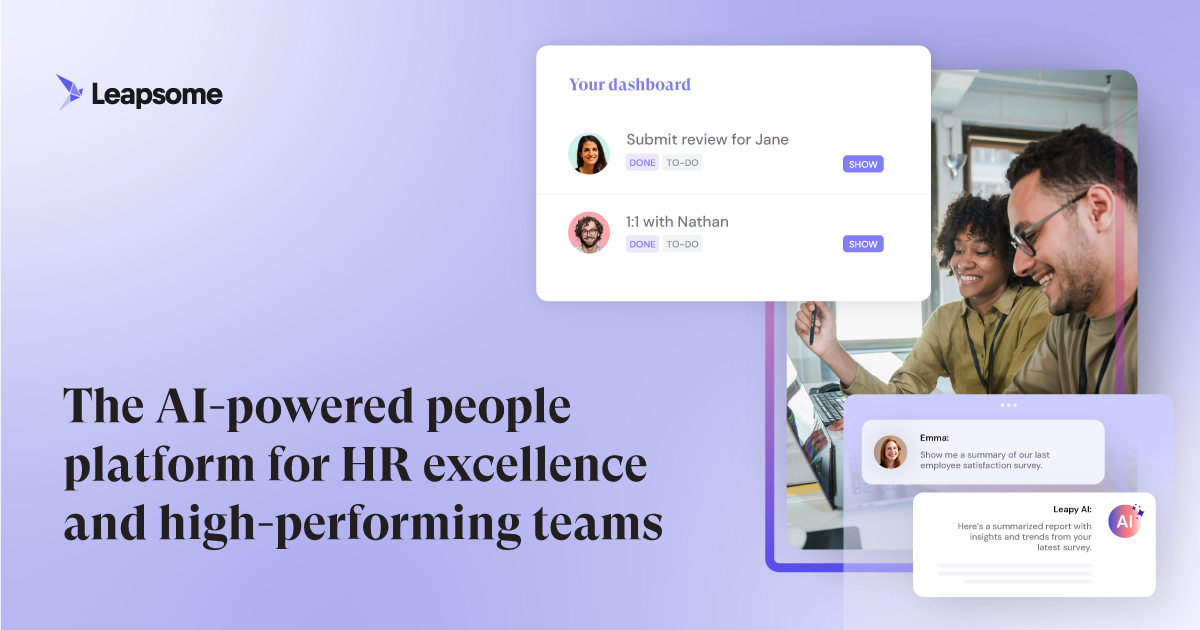
Leapsome has quietly built one of the most complete people management platforms on the market. Combining a modern HRIS with performance reviews, OKR tracking, engagement surveys, learning paths, and compensation management, it does what most competitors require two or three separate tools to accomplish. Trusted by over 2,000 organizations including Spotify, Mercedes-Benz, Notion, and monday.com, it occupies a distinctive position: genuinely trying to unify people operations and talent development under one roof.
The result is a platform that is impressively capable but not without trade-offs. The modular pricing model means costs climb quickly when you need more than the basics. The sheer breadth of features creates a learning curve that can overwhelm smaller teams. And despite strong web-based functionality, the lack of a dedicated mobile app remains a notable gap. Still, for mid-sized companies that want to stop juggling disconnected HR tools, Leapsome is one of the strongest options available right now.
What Is Leapsome?
Leapsome is an AI-powered people platform founded in 2016 by Kajetan Armansperg and Jenny Podewils in Berlin, Germany. The company was bootstrapped and profitable before raising a $60 million Series A from Insight Partners, Creandum, and Visionaries Club in March 2022. It now operates out of dual headquarters in Berlin and New York, employs approximately 140 people, and generated an estimated $30.5 million in revenue in 2024.
The platform’s core premise is that HRIS data and talent management should live in the same system. Rather than treating employee records, payroll prep, and performance management as separate concerns, Leapsome connects them so that people decisions are informed by real performance, engagement, and development data. It serves companies across technology, SaaS, professional services, finance, media, healthcare, and consulting, with particular strength among organizations with 50 to 1,000 employees.
Leapsome Key Features
HRIS and Core People Operations
Leapsome’s HRIS module handles employee record management, secure document storage with e-signatures, structured preboarding and onboarding workflows, absence tracking, time recording, and payroll preparation. It includes DATEV integration for companies with German payroll needs and compliance tools including whistleblowing reporting channels. What sets it apart from standalone HRIS tools is that this data feeds directly into performance reviews, goal tracking, and compensation decisions rather than sitting in an isolated silo.
Performance Reviews and 360-Degree Feedback
The performance review system is one of Leapsome’s strongest modules. It supports configurable review cycles (annual, quarterly, semi-annual, project-based, or continuous), customizable templates, and full 360-degree feedback. Workflow restrictions ensure employees only see finalized reviews when all parties have completed their assessments. Review transfers between managers are supported, which matters during organizational restructuring.
AI-powered review writing is a recent addition. The AI assistant draws on past performance data, goals, and feedback history to help managers draft more detailed and consistent reviews. This is genuinely useful for reducing the “blank page” problem that plagues review season, though it works best when the system already contains substantial data on each employee.
Goals and OKR Management
Goals can be aligned hierarchically across individual, team, and organizational levels. Real-time dashboards show progress, and AI-powered goal setting can generate OKRs from natural language prompts. Goal-based event triggers allow automated workflows when milestones are reached. The visual alignment view makes it easy to see how individual contributions connect to company objectives, which is a meaningful advantage over platforms that treat goal tracking as an afterthought.
One recurring complaint: viewing goal history requires too many clicks. If your organization runs quarterly OKR cycles, navigating between past and current cycles can feel cumbersome.
Employee Engagement Surveys
Leapsome offers customizable engagement surveys built from psychologist-designed question libraries. Surveys support anonymous responses, pulse survey scheduling, heat-map reporting, and industry benchmarks for comparison. The AI-generated survey summaries are a standout feature: rather than manually sifting through hundreds of open-text responses, the AI extracts themes and generates actionable insights automatically.
The limitation here is survey editing. Once a survey cycle is live, making changes is restricted, which can be frustrating if you discover a poorly worded question mid-deployment. Plan your survey templates carefully upfront.
Continuous Feedback and Recognition
Beyond formal review cycles, Leapsome supports instant feedback and peer-to-peer praise. Feedback integrates with Slack and Microsoft Teams, making it easy to give recognition without leaving the tools teams already use daily. The feedback history for each employee builds over time and feeds into performance reviews, creating a more complete picture than annual-only review systems provide.
Learning and Development
The L&D module includes a content library, customizable learning paths, career development frameworks, and skill tracking. Individual development plans can be linked directly to performance review outcomes and goals. The Form Builder connects to goals and learning paths, creating continuity between what someone needs to improve and the resources available to help them.
This is an area where Leapsome is functional but not best-in-class. Organizations with complex training requirements or large content libraries may find the learning module somewhat basic compared to dedicated LMS platforms. It works well for structured development paths tied to performance outcomes, less well as a standalone training system.
Compensation Management
Compensation reviews can be tied directly to performance data, goals achieved, and competency assessments. Integration with Figures provides compensation benchmarking data. However, the compensation review interface has drawn criticism for being a long, unwieldy form that becomes tedious for managers handling many direct reports. If compensation management is a primary use case, evaluate this module carefully during the trial.
AI Copilot and Analytics
The AI Copilot works across the platform, providing summaries, insights, and recommendations. Meeting Coach analyzes meeting transcripts to surface coaching opportunities. Analytics dashboards provide custom reporting, ad-hoc queries, and competency-level insights with visual output that multiple sources describe as excellent. The AI capabilities are meaningfully ahead of many competitors in this space, particularly for survey analysis and review drafting.
1-on-1 Meeting Management
Leapsome provides structured tools for recurring 1-on-1 meetings, including ready-to-use agenda templates, action item tracking, and integration with Google Calendar and Outlook. Meeting notes persist across sessions, though some have noted that notes from previous meetings occasionally appear in new meeting contexts when they shouldn’t. Meeting notifications can also persist after meetings have been cancelled, a minor but annoying bug.
Leapsome Pricing and Plans
Leapsome does not publish specific pricing on its website. The platform uses a modular, per-user-per-month pricing model where you select the modules you need and receive a customized quote. Multi-module and volume discounts are available, and annual billing is standard.
Based on our research across multiple sources, pricing starts at approximately $8 per user per month for base modules, though this figure is not officially confirmed by Leapsome. Volume pricing reportedly reduces the per-user cost significantly: organizations with 100 to 500 users may see rates closer to $5 per user per month, and those with 1,000+ users could pay as little as $3 per user per month. These figures should be verified directly with Leapsome’s sales team.
| Detail | Information |
|---|---|
| Pricing Model | Per user, per month (modular) |
| Estimated Starting Price | ~$8/user/month (third-party estimates; confirm with vendor) |
| Billing | Annual (yearly subscription discounts up to 15% reported) |
| Free Plan | No |
| Free Trial | Yes, with full platform access |
| Volume Discounts | Yes, for multi-module and larger teams |
| Implementation Cost (SMBs) | Estimated $500 to $2,000, with 2-4 week timelines |
| Enterprise Pricing | Custom quotes available |
One critical consideration: the modular pricing structure means costs escalate quickly. A company of 40 to 50 employees that needs performance reviews, engagement surveys, learning, and the HRIS will pay substantially more than the base per-user rate. Several mid-sized teams have flagged this as a pain point, noting that paying per module rather than getting all-access pricing becomes expensive at the 40+ employee mark. Request a comprehensive quote covering all modules you anticipate needing before committing.
Leapsome is currently running a switching promotion: organizations migrating from another HRIS pay nothing for the Leapsome platform until their old contract ends (maximum December 2026). This can significantly reduce the cost of switching if you time it correctly.
Integrations
Leapsome’s integration ecosystem is one of its competitive strengths, particularly for organizations that already use established HR and recruiting tools.
HRIS and People Data Sync: Personio, BambooHR, ADP, HiBob, Workday, Paycor, PayFit, Paylocity, PeopleHR, Remote, Nmbrs, Officient, Paychex, and Proliant. These bidirectional syncs are especially useful for companies transitioning to Leapsome’s own HRIS gradually.
Applicant Tracking Systems: Greenhouse, Lever, Workable, Ashby, Recruitee, Teamtailor, Zoho Recruit, JazzHR, SmartRecruiters, BreezyHR, Cornerstone OnDemand, Spark Hire Recruit, d.vinci, and Zvoove. The ATS integration breadth is notable and supports seamless onboarding workflows from hire to first review.
Payroll: DATEV (critical for German market operations) and ADP Workforce Now (significant for US-based companies needing payroll data sync).
Communication and Productivity: Slack and Microsoft Teams for feedback notifications, praise, and meeting reminders. Google Calendar and Outlook for scheduling integration. SSO support is included for enterprise identity management.
Outbound Integrations: Urban Sports Club (employee wellness), Bonusly (rewards and recognition), Figures (compensation benchmarking), and Moss (spend management).
Developer Tools: REST API, Zapier support, and webhooks for custom integrations. The Zapier connection opens up connectivity to thousands of additional tools, partially offsetting the platform’s smaller native integration library compared to more established HR suites.
The integration list is solid for a company of Leapsome’s size, but it is not as deep as what you would find with Workday or BambooHR’s ecosystems. Organizations with niche or legacy tools should verify specific integration availability during the evaluation process.
Customer Support
Leapsome offers multiple support channels: live chat, email, phone, and a 24/7 live representative option. A knowledge base at help.leapsome.com provides self-service documentation, and the company hosts a Slack community for HR professionals to share best practices and get peer support.
Free personalized demos are available and serve as part of the onboarding process. Implementation for small and mid-sized businesses typically takes 2 to 4 weeks, with estimated costs between $500 and $2,000 depending on configuration complexity. Leapsome provides onboarding assistance during this period.
Support quality is generally well-regarded. The team is responsive and helpful, particularly for setup and configuration questions. However, the initial learning curve means that organizations should budget time for training beyond just the implementation period. The platform’s breadth means that HR administrators need to understand how modules interconnect to get full value, and that requires more than a quick onboarding session.
Pros and Cons
After thorough evaluation of Leapsome’s capabilities, pricing structure, and real-world performance, here is our assessment of the platform’s strengths and weaknesses.
Pros
- Comprehensive all-in-one platform combining HRIS, performance reviews, OKRs, engagement surveys, learning, and compensation in a single system
- AI capabilities are ahead of most competitors, particularly for review drafting, survey analysis, and goal generation
- Highly configurable review cycles with support for annual, quarterly, project-based, 360-degree, and continuous feedback
- Strong integration ecosystem with major HRIS platforms, ATS tools, Slack, Microsoft Teams, and API/Zapier support
- Supports 11 languages with GDPR compliance and ISO 27001 certification, making it well-suited for European and multinational teams
- Hierarchical goal alignment provides clear visibility from individual contributions to organizational objectives
- Clean, modern interface with strong analytics and visual reporting
Cons
- Modular pricing becomes expensive quickly for mid-sized teams needing multiple modules, with significant gap between starting price and total cost
- Steep learning curve due to the breadth of features; requires significant upfront configuration effort for review templates and competency frameworks
- No dedicated iOS or Android mobile app; mobile experience limited to responsive web interface
- Learning and development module is functional but basic compared to dedicated LMS platforms
- Compensation review interface is cumbersome, described as a long form that becomes tedious for managers with many reports
- Survey editing restrictions prevent changes once a survey cycle is live
- Some navigation issues including too many clicks to view goal history and persistent meeting notifications after cancellation
Who Should Use Leapsome?
Best fit: Mid-sized companies with 50 to 1,000 employees in technology, SaaS, professional services, finance, or consulting that want to consolidate multiple HR tools into a single platform. If you are currently running separate systems for performance reviews, engagement surveys, and employee data management, Leapsome’s integrated approach eliminates data silos and reduces tool sprawl.
Ideal for tech-savvy HR teams that want AI-assisted workflows. The AI review writing, survey analysis, and goal generation features deliver real productivity gains, but only if your team is willing to adopt them and feed the system enough data to make AI outputs useful.
Strong for European companies or those with EU operations. GDPR compliance, ISO 27001 certification, DATEV payroll integration, and support for 11 languages (including German, French, Dutch, Swedish, and more) make Leapsome particularly well-suited for European or multinational organizations.
Not ideal for very small teams (under 30 employees). The modular pricing becomes disproportionately expensive at smaller scales, and the platform’s complexity is overkill for teams that could manage with simpler tools. Companies under 30 employees would likely find better value with a lighter-weight platform like 15Five or Lattice’s basic tier.
Not the best choice for organizations needing a dedicated LMS. If advanced training content management, SCORM compliance, or large-scale course delivery are primary requirements, Leapsome’s learning module will feel limited. Pair it with a dedicated LMS or look at platforms that specialize in learning.
Skip it if you need a mobile-first experience. Field teams, retail organizations, or any workforce that primarily accesses HR tools from phones will find the lack of a dedicated mobile app a meaningful limitation.
Leapsome Alternatives
Lattice
Lattice is the closest direct competitor, offering performance management, OKRs, engagement, compensation, and (more recently) HRIS capabilities. It has a larger user base and a more polished mobile experience. However, Lattice’s AI features are less advanced than Leapsome’s, and its HRIS module is newer and less mature. Choose Lattice if mobile access and a larger integration ecosystem matter more than AI-powered analytics.
Culture Amp
Culture Amp is strongest in employee engagement surveys and people analytics, with industry-leading survey science and benchmarking data. Its performance management features are solid but less configurable than Leapsome’s. It lacks a built-in HRIS. Choose Culture Amp if engagement measurement and organizational psychology insights are your top priority and you already have a separate HRIS.
15Five
15Five focuses on continuous performance management with weekly check-ins, OKRs, and engagement features at a lower price point. It is simpler to set up and adopt but offers less depth in reviews, learning, and compensation. It has no HRIS module. Choose 15Five if you are a smaller team (under 100 employees) that values simplicity and fast adoption over comprehensive feature coverage.
HiBob (Bob)
HiBob is a modern HRIS-first platform with performance management, time tracking, and compensation features built on top of strong core HR. It has a more intuitive onboarding experience and a slicker UI for everyday HR tasks. Its performance and engagement capabilities are less deep than Leapsome’s, and it lacks the AI-powered review and survey features. Choose HiBob if your primary need is a modern HRIS with adequate (not advanced) talent management features.
Workleap (formerly Officevibe)
Workleap provides lightweight employee engagement, performance, and recognition tools at a competitive price. It is easier to deploy and adopt than Leapsome but significantly less comprehensive. No HRIS, no learning module, and limited compensation features. Choose Workleap if you want a focused engagement and feedback tool without the complexity of a full platform.
Frequently Asked Questions
Does Leapsome offer a free trial?
Yes. Leapsome offers a free trial with full access to the platform’s functionality. During the trial, you can invite all company colleagues and test demo assessment cycles, learning modules, instant feedback, goal setting, surveys, and all core features. Contact Leapsome’s sales team or sign up through their website to start the trial.
How much does Leapsome cost?
Leapsome uses a modular, per-user-per-month pricing model. The company does not publish specific prices on its website. Third-party sources estimate starting prices around $8 per user per month, with volume discounts for larger organizations. You will need to contact Leapsome’s sales team for a customized quote based on your team size and selected modules.
Does Leapsome have a mobile app?
Leapsome does not currently offer a dedicated iOS or Android mobile app. The platform is accessible through a mobile-responsive web interface, which works for basic tasks like submitting feedback or checking goals. However, the full experience is optimized for desktop browsers, and the absence of a native app is a frequently cited limitation.
What languages does Leapsome support?
Leapsome supports 11 languages: English, German, French, Spanish, Portuguese, Italian, Dutch, Japanese, Korean, Chinese (Simplified), and Swedish. This makes it a strong fit for multinational organizations operating across Europe and Asia.
Is Leapsome GDPR compliant?
Yes. Leapsome is GDPR compliant and holds ISO 27001 certification. The platform uses industry-standard encryption and provides compliance tools including whistleblowing reporting channels. Its Berlin headquarters and European roots make privacy compliance a core design principle rather than an afterthought.
How long does it take to implement Leapsome?
For small and mid-sized businesses, implementation typically takes 2 to 4 weeks. The timeline depends on which modules you are deploying, the complexity of your review templates, and whether you need data migration from existing tools. Leapsome provides onboarding assistance during setup, though some upfront effort is required to configure review templates and competency frameworks to your organization’s needs.
Can Leapsome integrate with my existing HRIS?
Yes. Leapsome integrates with most major HRIS platforms including Personio, BambooHR, ADP, HiBob, Workday, Paycor, PayFit, Paylocity, and others. This allows organizations to sync employee data bidirectionally, which is particularly useful if you plan to adopt Leapsome’s HRIS module gradually while maintaining your existing system during the transition.
The Bottom Line
Leapsome is one of the most ambitious and capable people platforms available for mid-sized organizations. Its combination of HRIS, performance management, engagement surveys, learning, compensation, and AI-powered analytics in a single system is genuinely differentiated. The platform does what it promises: it connects people data to talent decisions in a way that most modular tool stacks simply cannot replicate.
The trade-offs are real, though. The modular pricing model can get expensive quickly, particularly for teams of 40 to 200 employees that need multiple modules. The learning curve is steeper than simpler alternatives like 15Five or Workleap. The absence of a dedicated mobile app is a gap that matters for distributed or frontline workforces. And some modules, particularly learning and compensation management, do not yet match the depth of specialized tools in those categories.
We rate Leapsome 4.3 out of 5. For technology companies, SaaS businesses, professional services firms, and other knowledge-work organizations with 50 to 1,000 employees, it is one of the best platforms in its class. If you want a single system that handles both the administrative side of HR and the strategic side of talent development, and your team is willing to invest in proper setup and adoption, Leapsome delivers strong, measurable value. Just make sure you model the total cost across all the modules you need before signing, because the starting price and the actual price can be very different numbers.